

Think about this: In Mumbai, it’s March 9, 1951. A newborn baby is put in his father’s arms, and instead of saying prayers like usual, the most amazing blessing in music history is about to happen. What happened next not only made a legendary tabla virtuoso, but it also started a rhythmic revolution that would last for seven decades and spread across continents.
The Most Enchanting Story of Birth in Music History
Zakir Hussain‘s fate was sealed by his father’s revolutionary act of love. As Zakir himself said in what has become the most touching origin story in music: “I was brought home and handed over to my dad in his arms.” It was customary for the father to whisper a prayer in the baby’s ear, welcoming the baby and saying nice things. He picks me up and puts his lips to my ear to say the tabla rhythms.
What did his mother do that made her so mad? “My mom was furious. “What are you doing?” she asked. You should say “prayers,” not “rhythms.”
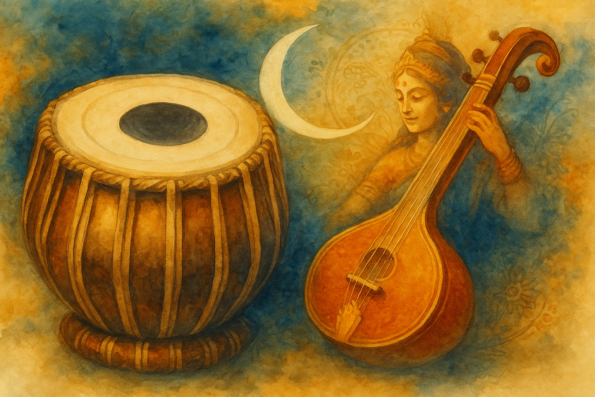
But Ustad Alla Rakha’s answer was pure poetry: “But these are my prayers.” This is how I pray. I worship the Goddess Saraswati and Lord Ganesh. This person was a very religious Muslim. He said that this was what he learned from his teachers and that he wanted to pass it on to his son. The Prodigy Who Bought a Lot of Gulab Jamun.
By the time he was seven, this rhythmic blessing had turned into pure genius. At a school concert, Zakir got paid for his first performance and made 100 rupees, which was a lot of money for a kid. His unforgettable response was, “It was enough to buy a mountain of gulab jamun.” He was already touring professionally at the age of 12. By the time he was 19, he was living in a barn at Mickey Hart’s California ranch, ready to take over the world.
The Awards That Tell a Great Story
National Awards:
• Padma Shri (1988) – India’s fourth-highest civilian award at age 37
• Padma Bhushan (2002) is the third-highest award for civilians.
• Padma Vibhushan (2023) is the second-highest honor for civilians.
• Fellowship (2018) and the Sangeet Natak Akademi Award (1990)
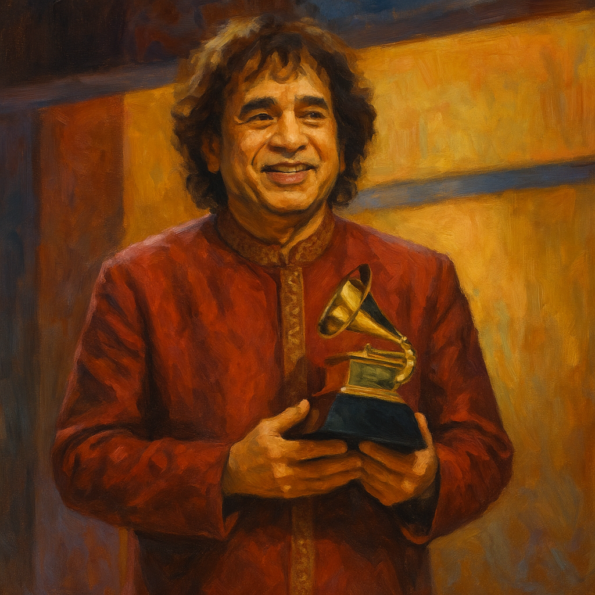
• Four Grammy Awards, three of which were given out in one night (2024)
• National Heritage Fellowship (USA, 1999) – The highest award for traditional artists
• Officier of the Order of Arts and Letters (France, 2006)
There were three big wins at the 2024 Grammys: Best Global Music Album for Shakti’s “This Moment,” Best Global Music Performance for “Pashto,” and Best Contemporary Instrumental Album for “As We Speak.”
John McLaughlin’s Destiny Declaration
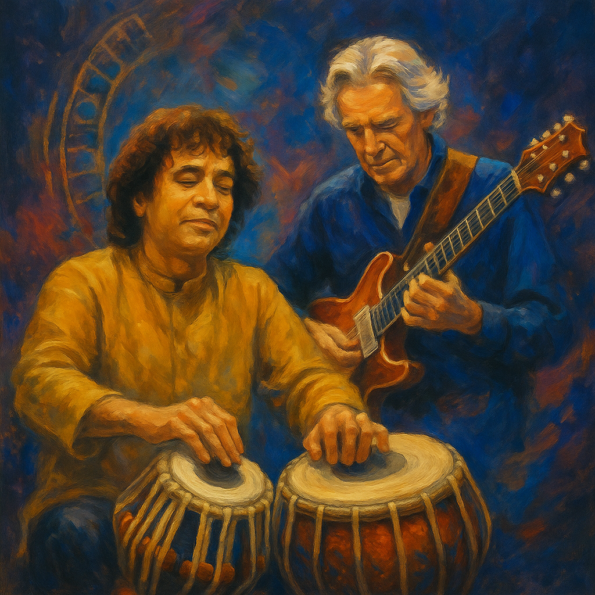
The making of Shakti sounds like musical fate. John McLaughlin, a famous British guitarist, needed a tabla player for his groundbreaking East-West fusion. Alla Rakha’s advice was deep: “I can’t play with you because I play the quietest instrument in the world and you play the loudest.” But my son could play with you. “I will send him to you.”
What did McLaughlin think of teenage Zakir at first? “It was like magic.” McLaughlin left his hugely successful Mahavishnu Orchestra in 1973 to work with them on what we now call World Music. This was a bold move for him.
What were the results? “There wasn’t a first meeting,” McLaughlin said. It was like getting back together with long-lost brothers. Mickey Hart’s 50-Year Brotherhood
Mickey Hart, the drummer for the Grateful Dead, said, “On December 15 at 3:42 pm, we lost one of the greatest rhythmists that has ever lived on this planet.” This may be the best tribute to Zakir’s genius. Zakir Hussain was my brother for more than 50 years, my best friend, and my closest coworker.

In 1991, their Planet Drum project won the first Grammy for Best World Music Album. Hart said of their work together, “We played for four days and nights!” Four days and nights! We played together every day and got to know each other very well. He was the crown prince of tabla, and when his father died, he became the king.
The most telling thing about their relationship is that “his instruments were like the rains, dense sheets of sounds…” He knew more about the rhythms of both the western and eastern worlds than anyone else. He could remember the most complicated rhythmic cycles perfectly and had perfect pitch.
The Philosophy That Made a Legend
What set Zakir apart from other musicians was how deeply he understood music as a way to talk to God. His most famous quote is, “What do I bring to the tabla?” I believe it is openness and clarity… What I show has to make sense, whether it’s a deep connection between the musician and the instrument or no doubt in my mind.
About his relationship with his instrument: “I can’t imagine that we will ever get tired of each other… The tabla was like the whole universe to me, like the Milky Way, begging to be explored.
His humility in spite of great success: “Music is an endless ocean, and I am just a humble sailor…” There is always more to learn in music and in life. It never stops. My music and I are the same. “It’s my medium; all my feelings are in it.”
The Zakir Hussain Universe: An Essential Playlist
The Shakti Revolutionary Tracks:
• “Shrini’s Dream,” a Grammy-winning song from “This Moment”
• Breaking the Rules (Cross-cultural fusion perfection)
• Joy (Shakti genius from the 1970s)
The Planet Drum Rhythms from around the world:
• Baba (with samples from Babatunde Olatunji)
• Under One Groove (a mix of electronic and percussion music)
• King Klave (a celebration of universal rhythm)
Mastering Solo Classical:
• Different interpretations of Raga with tabla as the main instrument • Worked with Ravi Shankar, Ali Akbar Khan, and Shivkumar Sharma
• Devotional works that show how rhythm can connect people spiritually
The Numbers That Show the Legend
His streaming and performance numbers are through the roof:
• More than 150 concerts every year during his best touring years
• Collaborations with almost every major Indian classical artist over the course of six decades
• The Global Drum Project album was at the top of the world music charts for months. • Shakti’s “This Moment” was their first studio album in 45 years.
The Most Moving Tributes : From other musicians, the tributes show how much Zakir meant to them.
Tanmoy Bose, who plays percussion: “He was my guru, and I really believe that a genius like him, who made the tabla famous around the world, will always be with us. He was the best traditionalist, but he also started trends.
From an interview with Osho in 1988: Zakir’s answer to the question about becoming famous at such a young age was typical: “I slept for about two hours last night… But when I listened to Bhagwan, I felt like I was talking. He was saying what I wanted to say.
The Legacy of the Revolution

Zakir didn’t just play tabla; he “gave tabla a new identity” by making it the main voice instead of just an accompaniment. “In the world of Indian classical music, Zakir Hussain changed the way the tabla was used.” His approach was revolutionary. He made it a main part of performances instead of just a supporting instrument.
His advice to young musicians was, “Don’t try to be a Master son, just be a student.” This perfectly summed up his philosophy of lifelong learning.
The Rhythm That Goes On
Zakir died on December 15, 2024, but his last projects still inspire us. At the time of his death, the live Shakti album was being mixed and mastered, and there were concerts planned for the next month. His last Grammy wins in February 2024 were not the end of his career, but the peak of it.
The decision? Zakir Hussain didn’t just make music that people want to listen to; he also made a new language of rhythm that speaks to people of all ages and cultures. His beats became the heartbeat of all music, from the soft tabla rhythms whispered in a newborn’s ear to the Grammy thunder that shook the world.
Zakir Hussain showed that rhythm is really the universal language in a world that is often divided by borders. His tabla didn’t just keep time; it kept hope alive, showing that music can really bring all hearts together in perfect harmony. The rhythms his father whispered are now forever part of the symphony of human expression.